PANTHER: A DISTRIBUTED HIGH-PERFORMANCE COMPUTING INFRASTRUCTURE
Project Funding:
National Science Foundation
Division of Experimental and Integrated Activities
NSF Program Manager: Dr. Stephen R. Mahaney
Project Leaders:
Prof. Prithviraj Banerjee
Prof. Alok Choudhary
Prof. Scott Hauck
Prof. Der Tsai Lee
Prof. Majid Sarrafzadeh
Prof. Peter Scheuermann
Prof. Valerir Taylor
Introduction to the Project
As the use of high-speed networking moves from the laboratory
to the workplace, new opportunities
arise for the design and implementation of a high-speed
distributed computing environment.
The goals of the PANTHER (Parallel And NeTworked High-performance EnviRonment) project are:
-
To explore the use of high-speed networking and computing
to investigate file systems and data management issues
for high-performance distributed computing,
-
To investigate the parallel programming support of
networks of high-speed workstations
as an alternative to stand-alone parallel computers,
-
To study high-performance computer-aided
design of electronic systems in a heterogeneous environment,
and to develop a Web-based CAD computing center,
that takes advantage of high-speed networking,
-
To explore new instructional techniques that take
advantage of the high bandwidth and high speed.
This project deals with the acquisition of the following equipment:
-
20 high-performance
HP C-180 UNIX workstations
with 180 MHz PA-8000 CPU, 128 MB memory, 2 GB disk, and 20 inch color monitors, and HPA-200 ATM cards.
-
50 medium performance HP B132 UNIX workstations
with 130 MHz PA-7300 CPU, 128 MB memory, 2 GB disk, and 17 inch color monitors, and HPA-200 ATM cards.
-
9 HP ATM-200 cards for nine existing HP C-110 workstations in the department
purchased earlier.
-
Three HP J-282 UNIX fileservers
with two 180 MHz HP PA-8000 CPU, 25 MB memory, 16 GB disk, HPA-200 ATM cards.
-
An SGI Origin 2000 shared memory multiprocessor
with eight 195 MHz R10000 CPUs, 1 GB memory, 9 GB disk.
-
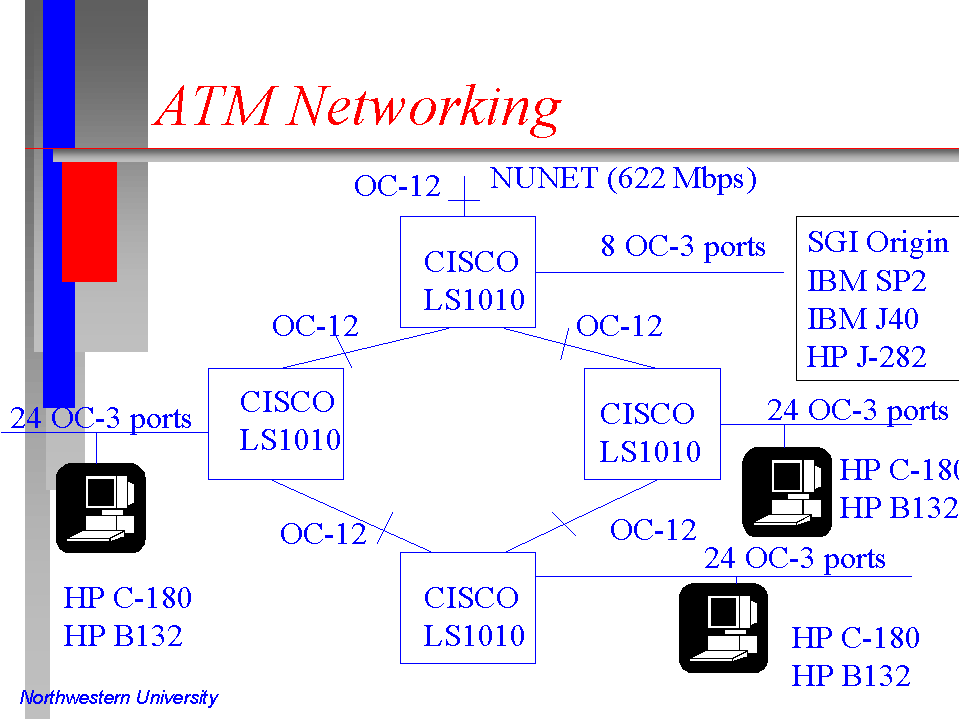
Four CISCO LightStream LS1010 ATM Switches each with 16 MB DRAM buffers,
two OC-12 ports, and 24 OC-3 ports.
The equipment will be networked as shown below.
Send any questions to
Professor Banerjee